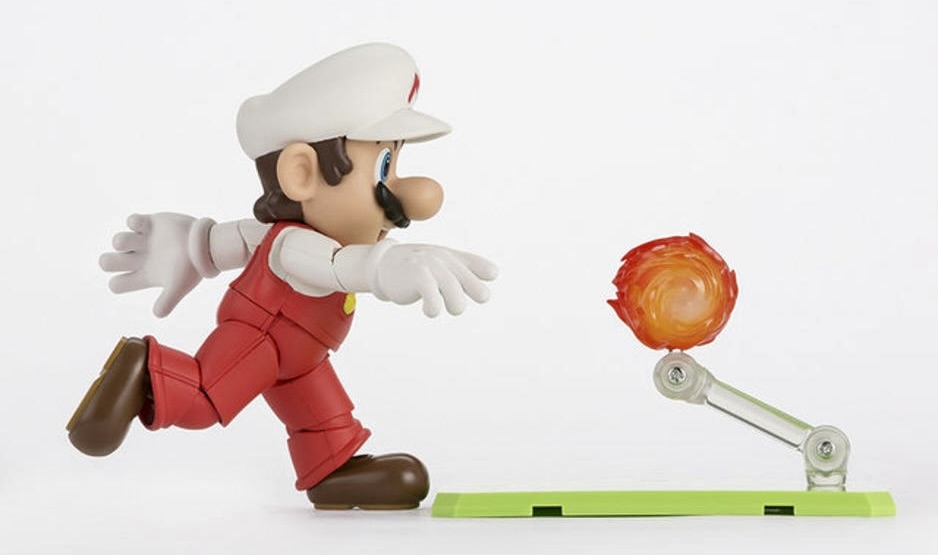
For decades, video game icons have transitioned from glowing CRT screens to plastic display shelves, but few character translations are scrutinized as intensely as Nintendo’s crown jewel, Super Mario. When Bandai Tamashii Nations launched their flagship S.H. Figuarts Super Mario line, it revolutionized the collector landscape. It proved that a high-end, highly articulated platform could capture the stylized, bouncy proportions of a video game mascot without sacrificing mechanical fidelity. Among the various iterations, colorways, and expansions, the S.H. Figuarts Fire Mario figure stands out as a holy-grail-tier piece for retro gaming enthusiasts. Released as a brilliant re-tooled expansion of the original vanilla Mario, this fiery variant embodies one of the most iconic power-ups in gaming history. But how does this collector-grade figure hold up under severe modern scrutiny? Does the switch to the classic red-and-white color scheme justify chasing it down on the secondary market? Let’s dive deep into the forge, geek out over the engineering, and deliver the definitive verdict on the S.H. Figuarts Fire Mario action figure.

Sculpt:
Evaluating any figure under the prestigious S.H. Figuarts banner means holding it to a standard of absolute source-material accuracy. Mario’s design is deceptively simple: an oversized head, spherical nose, thick mustache, round cap, and stout, stubby limbs. Yet, translating a cartoon mascot whose aesthetic is rooted in minimalism into a physical 3D object with fully functional mechanical joints is a masterclass in engineering restraint. The Fire Mario sculpt brilliantly bridges the gap between classic retro nostalgia and modern 3D rendering styles seen in titles like Super Mario 3D World and the Super Smash Bros. franchise. The proportions are delightfully squat and chunky, carrying a surprising physical heft that instantly communicates premium quality the moment you pull it from the blister pack.


Purists will immediately appreciate the historical nuance of the Fire Mario color swap. In the pioneering blueprint of Super Mario Bros. (1985), Fire Mario inverted his color scheme, sporting a stark white shirt paired with bright red overalls. Modern iterations—and by extension, this S.H. Figuarts release—invert this configuration: a crisp, brilliant white overall jumpsuit paired with a striking red undershirt, hat, and shoes. The head sculpt retains the cheerful, open-mouthed grin of the standard release, complete with the distinct tuft of brown hair poking out from beneath the cap and the signature round nose. It is clean, razor-sharp, and unmistakably Nintendo.
Paint Apps:
The absolute make-or-break element for a redeco figure like Fire Mario is its paint application. Shifting primary plastic colors from classic blue and red to stark white and vibrant crimson means any paint bleed, slop, or thin coverage will stick out like a stray Goomba in an empty room.
Fortunately, Tamashii Nations brought their absolute A-game to the factory floor:
- The Jumpsuit: The pristine white coat of the overalls features a rich, matte finish that expertly resists looking cheap or chalky. The panel lines sculpted directly into the cloth are cleanly accentuated, creating subtle shadow depth where the fabric drapes over his roly-poly frame.
- The Accents: The red elements—his shirt sleeves, collar, hat, and signature shoes—utilize a glossy, high-vibrancy crimson lacquer that pops aggressively against the stark white canvas.
- The Face & Tampo Details: The iconic “M” emblem printed front and center on his cap features laser-crisp edges with zero bleeding. His bright blue eyes are cleanly tampoed, and his thick mustache and eyebrows boast a solid, pitch-black finish.

A fun piece of trivia for eagle-eyed fans: while Mario’s hidden hair under his cap is sculpted with a distinct brown wash, his prominent mustache and eyebrows are pitch black. This accurately mirrors the digital character models of the era, proving that Bandai obsessed over the pixel-to-plastic translation.
Articulation:
If there is one aspect of the S.H. Figuarts Super Mario line that sparks heated debates across Reddit and collector forums, it is the articulation scheme. Because Mario completely lacks a conventional human neck and torso, Bandai had to innovate—resulting in a mechanical system that is equal parts functional and idiosyncratic.
- Head & Neck: Mario’s head rests on a ball-and-socket joint nestled tightly into his chin. Because he lacks an elongated neck, his vertical range of motion is inherently limited by the sheer volume of his head and cap. However, it swivels and tilts fluidly to catch dynamic shelf angles.
- Torso & Arms: This is where the articulation hits its primary bottleneck. There is no mid-torso crunch or waist swivel joint, meaning Mario cannot bend forward or backward organically. His shoulders use functional ball joints, but they are physically restricted by the thick, sculpted shirt sleeves. You won’t be pulling off high side-raises or dramatic crossed-arm poses here.
- Lower Body: The hips utilize a brilliant hybrid ball-and-hinge design, allowing his legs to swing outward, forward, and backward with surprising clearance. Combined with hinged knees and ball-jointed feet, Mario can achieve classic running stances and maintain a remarkably stable center of gravity on flat surfaces without a stand.

While hardcore collectors accustomed to hyper-malleable anime figures might find the movement restricted, it strikes a pragmatic balance that preserves the character’s seamless silhouette without shattering his iconic geometry with ugly joint gaps.
Accessories:
Unlike the original standard Mario release—which was infamously sparse on accessories to hit a lower entry-level price point (forcing fans to buy separate environmental playsets)—the Fire Mario box is packed to the brim with hardware that feels genuinely complete.

Inside the package, collectors get:
- The Fire Flower: A meticulously sculpted, beautifully painted power-up item featuring iconic orange-and-yellow petals and a clean green stem.
- The Fireball Effect Piece: A translucent, flaming orange-and-yellow energy orb that effortlessly attaches to recreate Mario launching an attack.
- Interchangeable Hands: Multiple sets of alternative hands molded precisely to grip the fireball or hold the flower securely.
- Dedicated Support Arms & Display Stage: Unlike the first release, which required purchasing separate stage kits, Fire Mario includes custom clear support arms and a branded Tamashii Nations display stage out of the box for aerial action poses.


Behind every S.H. Figuarts box lies a high-precision manufacturing pipeline utilizing dense PVC and ABS plastics. However, hunting for this figure on the secondary market comes with a stark warning:
- The Bootleg Epidemic: Due to the massive, enduring popularity of the Super Mario line, aftermarket hunters on eBay or AliExpress must stay vigilant. During the peak of the line’s run, notorious knockoffs (often called “Datong” bootlegs) flooded the wild. Legitimate Bandai releases feature official Nintendo licensing stickers, matte-finished plastics, and rigid joint tolerances, whereas bootlegs notoriously suffer from shiny, cheap plastic, warped facial tampo printing, and dangerously loose neck pegs.

For casual Nintendo fans and hardcore toy archivists alike, the S.H. Figuarts Fire Mario is a sensational shelf piece. Sure, its articulation carries the mechanical limitations of early-2010s Tamashii design, and the absence of an alternate stern or shouting facial expression remains a missed opportunity. Yet, what it lacks in deep abdominal articulation, it aggressively makes up for with undeniable shelf presence, gorgeous paint execution, solid build quality, and an accessory suite that instantly elevates any video game display. If you want to inject a blast of fiery nostalgia into your collection, this power-up is well worth securing. Let’s-a go! What specific character from the Mario universe do you think deserves the S.H. Figuarts treatment next?
