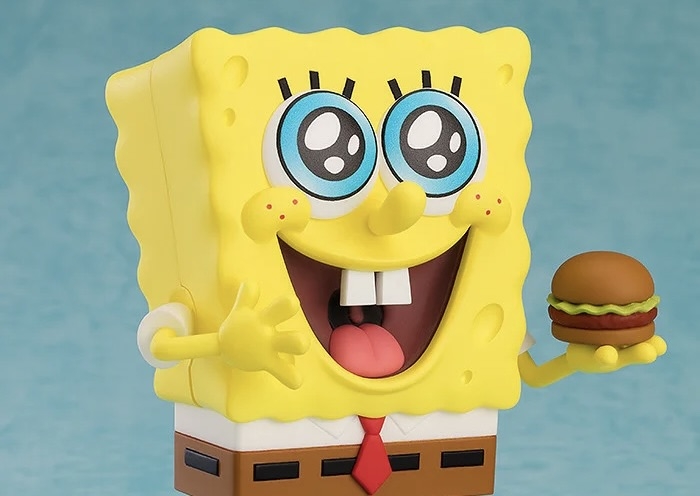
Nendoroid No. 1926 SpongeBob SquarePants is one of those releases that makes immediate sense the second it is in hand. SpongeBob’s square, oversized-headed cartoon design already lives close to the visual language of a Nendoroid, so Good Smile Company did not need to radically “chibi-fy” him. Instead, it delivered a compact, unusually expressive, fully licensed SpongeBob figure that feels less like a novelty and more like a deluxe animated-character action figure. The phrase “ultimate SpongeBob figure” gets thrown around casually, but it is not an unreasonable description here. Nendoroid SpongeBob does not try to compete with a large-scale statue, a plush toy, or a super-articulated collector figure with visible engineering everywhere. Its goal is simpler and smarter: give fans a highly screen-accurate SpongeBob with enough face, eye, limb, hand, food-service, and Gary-related options to recreate the character’s humor. That is exactly what it does.

For lifelong SpongeBob SquarePants fans, the appeal is immediate. This is a figure that can go from cheerful fry cook to confused sea sponge, from Krusty Krab employee to burger-flipping hero, from “I’m ready!” optimism to a pose that suggests Squidward has just heard the word “fun” one too many times. For collectors who are not deeply immersed in Bikini Bottom lore, it is simply an exceptionally well-made piece of animation merchandise with a rare ability to look good in almost any display. For figure collectors, Nendoroid No. 1926 also solves a problem that many Western-animation collectibles do not. It is genuinely poseable while still looking like the source material. A lot of SpongeBob figures are either inexpensive toys with very limited movement, static vinyl items, plush, or oversized decorative pieces. This release sits closer to the import-collector standard: compact, cleanly sculpted, packed with character parts, and made to be changed around.

What makes this figure special is that it understands which SpongeBob fans it is appealing to. It is not trying to represent a single episode, meme, movie, or specific era so narrowly that only deep-cut collectors will understand it. Instead, it pulls together the broadest and most beloved parts of SpongeBob’s identity. There is the classic uniform from the Krusty Krab, the spatula, the Krabby Patty, Gary, SpongeBob’s wide-eyed optimism, and enough alternate parts to suggest his capacity for chaos. This is the SpongeBob who has been a constant on Nickelodeon since 1999, who lives in a pineapple under the sea, who considers Patrick Star his best friend, who irritates Squidward without ever fully understanding why, and who remains comically loyal to Mr. Krabs despite absurd workplace conditions.

Good Smile’s Nendoroid line is built around stylized, articulated “chibi” figures with interchangeable expressions and parts. The format works especially well for anime, video games, and properties whose characters can be translated into oversized heads and compact bodies without losing their identity. SpongeBob is different because he barely needs that translation. He has always been a walking rectangle with a huge face, small limbs, large blue eyes, short brown pants, and a silhouette recognizable from an absurd distance. Stephen Hillenburg’s original character design is one of modern animation’s great feats of readability. You can identify SpongeBob from a pair of eyelashes, his buck teeth, or the outline of his pants. That makes Nendoroid No. 1926 feel unusually natural. It does not look like “SpongeBob converted into a Nendoroid.” It looks like SpongeBob given a premium action-figure budget. The result sits in an interesting middle ground. It has the swap-out components and display stand associated with a Japanese import collectible, but it retains the proportions of the actual cartoon. As another collector review noted, it does not quite read like a conventional Nendoroid because SpongeBob’s existing proportions already work; it instead feels closer to an “ultimate import version” of the character.
Sculpt and paint applications
The basic SpongeBob body is deceptively difficult to make interesting. On paper, it is a yellow rectangular block with a white shirt, red tie, brown shorts, striped socks, and black shoes. A cheap figure can technically include all of those colors and still look strangely lifeless. The difference is in the edges, face, texture, proportions, and paint separation. Good Smile gets the broad design right first. SpongeBob’s body is neither too thick nor too narrow, and the figure maintains the rounded, porous quality of the character without becoming covered in exaggerated sponge holes. The sculpt suggests the texture of his body through subtle surface dimples and controlled shaping. It looks clean from a normal display distance, yet has enough texture up close to avoid reading as a simple yellow block of plastic.

His face carries most of the display value. The buck teeth are properly centered and shaped, the nose is long without being too fragile-looking, and the cheeks have the soft, rounded cartoon geometry that makes SpongeBob look permanently on the edge of either a delighted smile or a full emotional breakdown. The eyes are especially successful. SpongeBob’s large blue irises and long eyelashes are probably the most important individual paint applications on the figure. If the eye placement is even slightly off, SpongeBob can look vacant or oddly unsettling. Here, the printed eye parts are sharp, bright, and full of the exaggerated optimism that defines the character.
The availability of three different eye sets is a clever choice. Rather than requiring Good Smile to produce numerous entire faceplates, the separate eyes create more combinations from relatively few parts. SpongeBob can look normally cheerful, startled, focused, suspicious, or more intensely happy depending on how the eyes are paired with the faceplates. It is efficient accessory design and especially effective for a cartoon icon who communicates almost everything through facial exaggeration. The paint on his outfit is crisp where it needs to be. The shirt, collar, tie, brown shorts, belt-like waist area, striped socks, and shoes are clearly separated. The red tie is particularly important because it acts as a small focal point beneath the enormous yellow face. On a figure this size, a sloppy tie or collar can make the whole body look cheap. Good Smile’s paint separation keeps the outfit recognizable and clean.

The Krusty Krab hat is another strong touch. It may be a small accessory, but it roots the figure in the version of SpongeBob most fans know best: the relentlessly enthusiastic fry cook whose devotion to the Krabby Patty borderlines on religious commitment. The tiny cap gives the figure a specific setting and identity. Without it, this is SpongeBob anywhere. With it, he is SpongeBob at work, likely about to tell Mr. Krabs that he is ready to start another shift. That association opens up a lot of fan-service display potential. Put the hat on, add the spatula hand, add the Krabby Patty hand, and the figure instantly becomes a tribute to the Krusty Krab. Place Gary alongside him and the setup starts to feel like a miniature Bikini Bottom scene rather than a lone cartoon figure on a shelf.
Accessories
SpongeBob includes two faceplates, three eye sets, two alternate bent arms, five extra hands, one bent leg, a Krusty Krab employee hat, a spatula, a Krabby Patty, Gary the Snail, and a stand. That accessory list may not look enormous beside a deluxe anime Nendoroid loaded with weapons, effect parts, and full alternate bodies. But the selection is extremely well chosen for SpongeBob. Every major extra refers back to the character’s personality, his workplace, his relationship with Gary, or the physical comedy of the series.

The face and eye combination system is the centerpiece. SpongeBob is a character capable of traveling from blissful joy to panic, embarrassment, terror, righteous anger, or oblivious confidence in a matter of seconds. His expressions are part of the show’s comedic timing. Good Smile’s parts selection allows the figure to reflect that without requiring an impractical pile of complete portraits. The result is especially useful for photography. With just the two faces, three eye sets, alternate arms, and bent leg, collectors can create a surprisingly broad range of scenes. The figure can look like he is proudly presenting a Krabby Patty, preparing to flip burgers, waving excitedly, running toward an off-screen adventure, or reacting to one of Patrick’s worse ideas.

The spatula is a must-have. SpongeBob’s job at the Krusty Krab is not merely background detail; it is the stage for a huge portion of the series. The Krabby Patty is arguably the single most important object in Bikini Bottom after the Krusty Krab itself. It is the business foundation of Mr. Krabs, the obsession of Plankton, the symbol of SpongeBob’s culinary pride, and the recurring excuse for chaos. The included Krabby Patty hand is especially smart because it keeps the food accessory visually stable and avoids the awkward “tiny loose burger in a tiny plastic hand” problem. In a figure format built around swappable hands, integrated accessories often provide the cleanest display result.
Gary’s inclusion is equally important. SpongeBob can work as a standalone collectible, but Gary immediately makes the set feel more complete. He is not just a pet; he is one of the show’s most enduring secondary characters, a dryly expressive counterweight to SpongeBob’s manic enthusiasm, and the source of some of the series’ more surprisingly emotional episodes.
Articulation
This is not a figure that needs extreme articulation to succeed. SpongeBob does not perform martial-arts kicks, wield swords, or require a dozen layers of costume engineering. His humor is largely built around simple but highly readable poses: arms thrown in the air, a goofy lean, a running stance, a burger held proudly, a hand on his hip, or an expression of absolute confusion. Good Smile wisely focuses the articulation where it matters. The arms can be swapped and repositioned, the hands change the mood of a pose, and the alternate bent leg breaks up the rigid rectangular silhouette. The bent-leg part is more valuable than it first appears. SpongeBob’s normal stance is naturally stiff because his body is a square. Giving him one raised or bent leg immediately creates the sense that he is moving, skipping, dancing, running, or reacting. The alternate bent arms serve a similar purpose. They help avoid the “arms straight at the sides” look that can make compact cartoon figures feel like static vinyl toys. A pose with a bent arm, a raised spatula, and a slightly angled eye set can tell an entire joke without needing a diorama.

The stand is necessary rather than optional. Good Smile specifically notes that the figure does not balance on its own and should be displayed using the included stand. That may disappoint collectors who prefer a completely clean, unsupported display, but it is a reasonable compromise. SpongeBob has narrow legs, a top-heavy rectangular body, and interchangeable limb parts. A stand prevents accidental shelf dives and makes more expressive poses possible. It is also worth remembering that a Nendoroid stand is generally part of the figure’s design language, not a failure of it. The support gives collectors the freedom to create a mid-step, tipped-forward, or action-oriented display that would be difficult with a freestanding figure.
Comparison with other SpongeBob figures
The Nendoroid is not the only premium SpongeBob collectible, but it occupies a particularly useful niche.
Mondo’s larger SpongeBob releases are built for fans who want size, bold presentation, and display-focused vinyl appeal. MEGA and other construction-toy formats focus more on scene-building and nostalgia. Jakks Pacific and similar mass-market brands have made SpongeBob figures accessible for younger fans and casual collectors, but their articulation, paint, and accessory design usually operate at a different price level.
Good Smile’s figure is the best choice for fans who want a high-quality, compact, poseable SpongeBob rather than a large statue or a toy-line-scale figure. Its approximately 100 mm height also makes it easy to place near other stylized collectibles, though it is not true scale with most six-inch action-figure lines. A reviewer noted that its roughly 3.9-inch height can still look surprisingly workable with other figures depending on the display, precisely because SpongeBob’s animated proportions are already so unconventional.
It also has a built-in advantage over many stylized SpongeBob figures: it feels authentic to the character without needing realistic textures or complicated updates. SpongeBob is a cartoon. He should look bright, clean, expressive, and a little absurd. Good Smile resists the temptation to over-engineer him into something more “collectible” at the expense of what makes him fun.

Nendoroid SpongeBob SquarePants is worth buying for fans who want a premium, highly poseable version of the character and appreciate the compact, accessory-driven Nendoroid format. It is especially easy to recommend if you want a figure that represents the classic Krusty Krab era of SpongeBob rather than a niche costume, one-off episode version, or movie-specific design. The limitations are minor but worth stating. It is not designed to stand freely without its support. The articulation is tailored to cartoon posing rather than extreme movement. Gary is small, the accessories are easy to misplace, and collectors expecting a huge amount of physical heft may be surprised by how light a 100 mm plastic import figure feels. Those points do not meaningfully hurt the experience. In fact, the figure’s small scale is part of why it is so easy to enjoy. It fits on a desk, beside a monitor, in a detolf, on a bookshelf, or within a mixed display of animation collectibles. It can be reposed quickly enough to stay fresh, and its expressions have enough personality to make a simple shelf arrangement feel intentional.

Nendoroid No. 1926 SpongeBob SquarePants is an excellent example of a licensed figure understanding both the character and the format. SpongeBob does not need to be radically reimagined as a chibi collectible because he was already perfectly suited to this kind of stylized, expression-heavy presentation. Good Smile instead refines the design with sharp paintwork, effective face and eye swaps, purposeful accessories, useful alternate limbs, a Krusty Krab uniform hat, a Krabby Patty, a spatula, and Gary. The sculpt captures SpongeBob’s cheerful simplicity without looking cheap. The paint is clean and vibrant. The accessories connect directly to the heart of the series. Most importantly, the figure is fun. It can be cute, goofy, nostalgic, absurd, and surprisingly display-worthy—sometimes all at once. If you are a SpongeBob SquarePants fan who wants more than a static desk ornament, this may be the most satisfying all-purpose SpongeBob collectible on the market. It is equally at home beside other Nendoroids, on a Nickelodeon nostalgia shelf, or posed proudly behind a tiny Krusty Krab counter with a Patty in hand and Gary looking on.

Leave a Reply