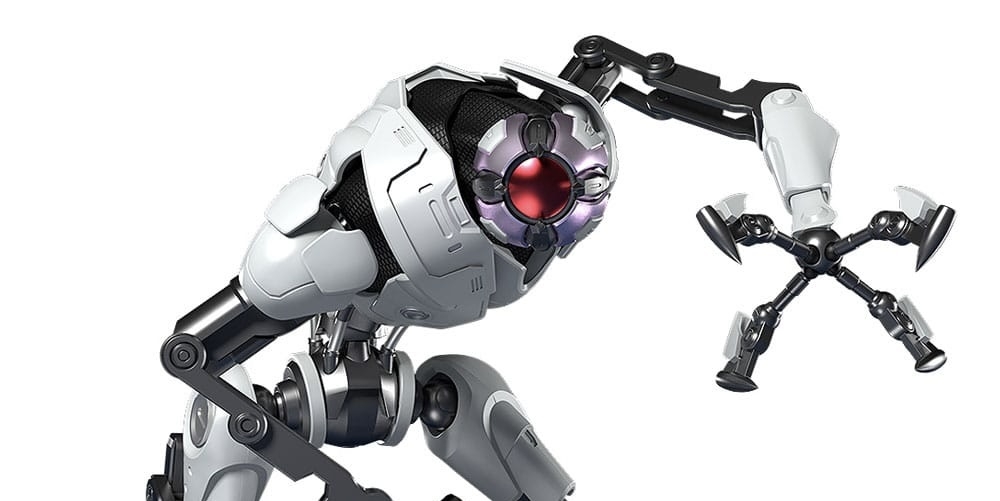
Few enemies in modern Nintendo history have made an impact as immediate and visceral as the E.M.M.I. units from Metroid Dread. These biomechanical predators — cold, clinical, and terrifyingly efficient — became the defining icon of Samus Aran’s latest adventure. They weren’t just obstacles; they were the embodiment of dread itself, stalking the player with unrelenting precision, their movements unsettlingly smooth and their audio design unforgettable. When Good Smile Company announced a figma E.M.M.I., expectations were sky‑high. Translating such a sleek, alien, hyper‑articulated machine into a physical figure is a challenge few manufacturers could pull off convincingly. The result is one of the most striking sci‑fi figmas ever produced — a premium, poseable, game‑accurate representation of one of Nintendo’s most memorable antagonists.

Everything about figma E.M.M.I. feels true to Metroid Dread. The proportions match the in‑game model exactly. The paintwork captures the sterile, clinical aesthetic of the E.M.M.I. units. The articulation supports the creature’s unsettling movement style. The sculpt preserves every mechanical detail, from the segmented limbs to the rib‑like torso structure. Even the figure’s posture — tall, looming, predatory — feels like a direct lift from the game. For collectors searching for the best Metroid Dread figure or a premium EMMI collectible, this figma is the definitive choice.
Sculpt
The E.M.M.I. design is a masterclass in unsettling elegance. It’s sleek yet insectoid, humanoid yet alien, with proportions that feel almost plausible for a real‑world quadrupedal robot. Max Factory’s sculpt captures this uncanny quality with remarkable fidelity. The limbs are long and spindly, with segmented armor plating that mirrors the in‑game model precisely. Each joint is sculpted with mechanical detail — pistons, ridges, and subtle panel lines that give the figure a sense of engineered complexity.

The head is one of the most iconic elements of the E.M.M.I. design, and the figma nails it. The central sensor — that glowing, circular “eye” that shifts colors depending on alert state — is sculpted with a smooth, glossy finish that contrasts beautifully with the matte armor surrounding it. The head shape is elongated and slightly forward‑tilted, giving the figure a predatory posture even in neutral poses. The torso is equally impressive. It features layered armor segments that overlap naturally, creating a sense of depth and realism. The rib‑like structures along the sides are sculpted sharply, and the central spine‑like column running down the back is faithfully reproduced. The proportions are exactly as they appear in Metroid Dread: unnervingly tall, unnervingly thin, and unnervingly flexible.
The limbs deserve special praise. The arms and legs are long and multi‑jointed, with sculpted mechanical details that maintain accuracy without compromising articulation. The hands — claw‑like and unsettling — are sculpted with sharp precision, each finger segmented and slightly curved, ready to grasp or strike. The feet are wide and flat, designed to support the figure’s weight while maintaining the E.M.M.I.’s distinctive stance. Overall, the sculpt is one of the most faithful video‑game translations in the figma line. It captures the E.M.M.I.’s biomechanical horror perfectly.

Paint Applications
The paintwork on figma E.M.M.I. is intentionally minimalistic — and that’s exactly why it works. The E.M.M.I. design in Metroid Dread is sleek and sterile, with a white armor shell that looks like advanced polymer plating. Max Factory’s paint application preserves that clinical aesthetic with a smooth, matte white finish that feels premium and futuristic. The subtle gray panel lines and mechanical accents are applied with precision, adding depth without overwhelming the design. The joints feature darker metallic tones that contrast nicely with the white armor, emphasizing the figure’s mechanical nature. The claws and feet use a slightly glossier finish, giving them a sharper, more dangerous appearance.

The central sensor is the paintwork’s highlight. It uses a glossy, reflective finish that makes it look like a real lens. The red coloration is vibrant and eye‑catching, immediately drawing attention — just as it does in the game when the E.M.M.I. enters its lethal pursuit mode. Under strong lighting, the sensor gleams in a way that feels almost alive. The overall paint application is crisp, clean, and perfectly suited to the character. There’s no sloppiness, no bleed, no unevenness — just a sterile, clinical finish that enhances the sculpt’s biomechanical precision.
Articulation
The E.M.M.I. is defined by movement. In Metroid Dread, it crawls, climbs, lunges, twists, and contorts with unsettling fluidity. Capturing that in a physical figure is a monumental challenge — but Max Factory’s articulation engineering rises to the occasion. The limbs feature multiple points of articulation, allowing for extreme poses that mimic the E.M.M.I.’s in‑game animations. The arms can stretch forward in predatory lunges, bend inward for scanning poses, or splay outward for wide, spider‑like stances. The elbows and wrists rotate smoothly, enabling expressive claw gestures. The legs are equally flexible. They can crouch low to the ground, extend into tall, towering stances, or bend into dynamic mid‑movement poses. The ankles offer enough tilt to maintain stability even in extreme positions, and the wide feet help distribute weight effectively.

The torso features a multi‑segment articulation system that allows twisting, leaning, and subtle curvature. This is crucial for recreating the E.M.M.I.’s signature movements — the slow, deliberate scanning posture, the sudden forward lunge, or the eerie, almost animalistic crawl. The head rotates and tilts with enough range to mimic the E.M.M.I.’s unsettling “searching” behavior. Combined with the expressive limbs, the figure can achieve poses that feel almost animated. This is one of the most poseable figmas ever released — not just in range, but in how naturally those poses reflect the character’s personality.

Accessories
The E.M.M.I. doesn’t need a large accessory loadout. Its design is its weapon, its presence its threat. Max Factory wisely kept the accessory selection minimal, focusing on elements that enhance the figure’s display potential without cluttering the package. The most important inclusion is the articulated figma stand, which is essential for achieving the E.M.M.I.’s more extreme poses. The stand allows for mid‑lunge displays, elevated crawling stances, and dynamic diorama setups alongside Samus figures. The DNA-extracting spike was a friendly addition. The alternate parts — including optional claws and joint segments — allow collectors to fine‑tune the figure’s silhouette. These additions are subtle but meaningful, giving the E.M.M.I. even more expressive range. The minimalist accessory approach suits the character perfectly. The E.M.M.I. is a presence, not a toolkit.


Metroid figures are rare, and high‑end Metroid figures are even rarer. Most Samus releases focus on her Power Suit or Varia Suit, leaving enemies underrepresented. The E.M.M.I. stands out as one of the few premium Metroid antagonists ever produced — and easily one of the best. Compared to mass‑market Metroid toys, the figma is vastly superior in sculpt detail, paint accuracy, and articulation engineering. Even compared to high‑end Samus figures, the E.M.M.I. holds its own, offering a unique biomechanical aesthetic that complements Samus’s armor beautifully. For collectors building a Metroid display, the E.M.M.I. is essential.

The figma E.M.M.I. (Metroid Dread) is one of Max Factory’s most impressive sci‑fi releases — a poseable, game‑accurate, beautifully sculpted figure that captures the biomechanical horror of one of Nintendo’s most memorable enemies. The paint apps are clean, the articulation is extraordinary, and the sculpt is a perfect translation of the in‑game design. For Metroid fans, this is a must‑own piece. For sci‑fi collectors, it’s a standout robot design. For figma enthusiasts, it’s a showcase of how to adapt complex mechanical characters without sacrificing poseability. It isn’t just a good Metroid figure — it’s one of the best figmas of its era.

Leave a Reply