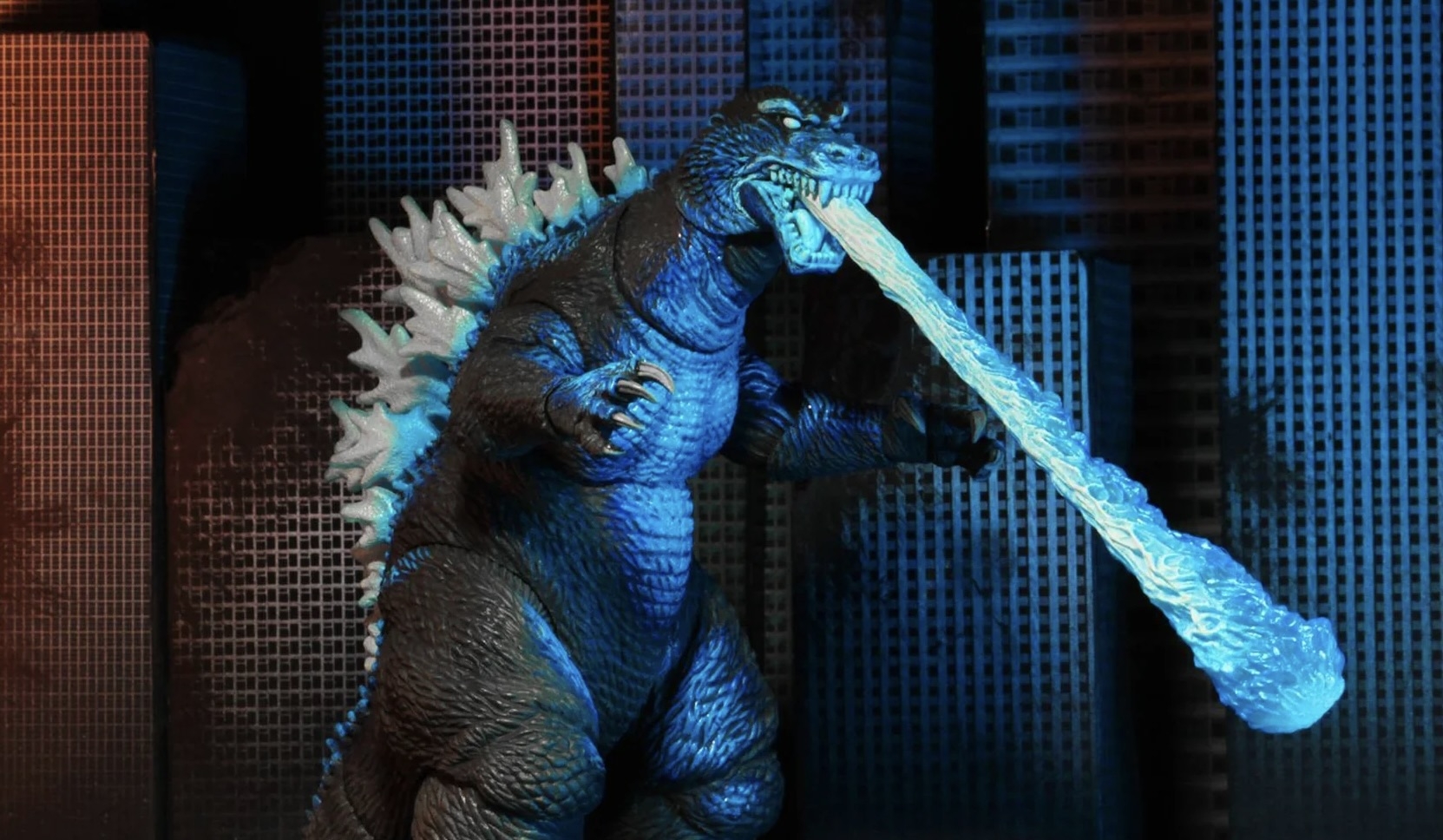
Before getting into the figure itself, it’s worth understanding why this specific incarnation of Godzilla has such a devoted following. Godzilla, Mothra and King Ghidorah: Giant Monsters All-Out Attack was directed by Shusuke Kaneko and released by Toho in 2001 as a deliberate reset of the character’s tone. Rather than continuing the more heroic, protector-of-humanity portrayal Godzilla had drifted toward in earlier eras, Kaneko reimagined Godzilla as a genuinely malevolent force of nature — a vessel for the restless souls of those who died in the Pacific during World War II, driven by hatred rather than instinct. That thematic shift demanded a correspondingly harsher design: a leaner, more hunched silhouette, jagged and asymmetrical dorsal spines, and most notably, pupil-less white eyes that strip away any sense of personality or sympathy from the creature’s face. It’s widely regarded among longtime Godzilla fans and franchise historians as one of the most effectively menacing takes on the character in the entire 70-year franchise, which is precisely why a dedicated action figure release has been a long-standing want among collectors. The “Atomic Blast” variant follows a well-established NECA pattern of releasing multiple deco variants of a popular sculpt — a practice the company has repeated across several of its most in-demand Godzilla releases, including later Shin Godzilla and King of the Monsters (2019) atomic-breath variants that use the same underlying design philosophy.

It’s important to set expectations correctly here: this isn’t an entirely new sculpt. The Atomic Blast release is a deco variant built on NECA’s existing GMK Godzilla Head-to-Tail body, repainted and re-accessorized to depict the character mid-attack, unleashing his atomic breath during a nighttime battle sequence. The most notable difference from the standard-release GMK figure is a darker, shadow-heavy base coat meant to simulate low-light conditions, with patches of luminous blue detailing across the body suggesting the ambient glow cast by the atomic breath itself. Collectors who already own the standard GMK Godzilla release should know going in that they’re largely paying for a striking new color story and an included effects piece rather than a fundamentally different figure — but for a character this visually iconic, that distinction matters less than it might for other releases, since the new deco genuinely changes the figure’s presence on a shelf.

Sculpt
NECA’s Head-to-Tail line has become the studio’s standard-bearer for affordable, large-format Godzilla figures, and the underlying GMK sculpt holds up well within that lineage. The figure stands over 6 inches tall, with a head-to-tail measurement exceeding 12 inches once the tail is factored in — a meaningful size that lets the asymmetrical dorsal spines, the hunched neck posture, and the character’s uniquely aggressive stance all read clearly at a glance. The sculpt captures GMK Godzilla’s leaner, meaner body language well: less bulky than NECA’s more heroic-era Godzilla releases, with a texture pass across the hide that holds up under close inspection.


Articulation
With more than 30 points of articulation, including a fully articulated tail, this remains one of the more posable large-scale Godzilla figures on the market at this price tier. The tail articulation deserves particular credit, since kaiju figures have historically struggled to make tails feel like more than an inert counterweight; here, it can be meaningfully arced and posed to complement dynamic battle scenes rather than just trailing behind the figure. Joint tightness is generally solid, though as with most NECA large-format figures, some looseness in the hips or shoulders after repeated posing sessions has been a recurring, if minor, complaint among long-term owners across the wider Head-to-Tail line rather than something isolated to this release.

Paint Applications
For the NECA Godzilla 2001, the paint application is designed to echo GMK’s bleak, hostile suit design rather than the bright energy effects of later figures. The core visual recipe is a dark charcoal-to-black body, layered gray dry-brushing that pulls the sculpted skin texture forward, comparatively lighter dorsal plates, and those unnerving opaque white eyes—the tiny detail that turns a normal monster figure into an accusation aimed directly at civilization.
The figure’s color treatment works because GMK Godzilla is not intended to look glossy, clean, or biologically inviting. This is a grimy, corpse-cold design with a body that should feel like it crawled out of a stormy sea carrying 50 years of unresolved national trauma. The paint should therefore emphasize texture and contrast, especially around the head, chest, scales, claws, teeth, and dorsal fins.

Accessories
The included atomic blast effect piece is the standout accessory: a removable beam effect that plugs into the figure’s mouth to simulate the character’s signature attack mid-blast. It’s compatible with other figures in NECA’s broader Godzilla Head-to-Tail line, giving owners some crossover display flexibility across their collection rather than being a one-off, single-use piece. Beyond the blast effect, this is a comparatively accessory-light release next to some of NECA’s more loaded licensed lines — there’s no additional interchangeable head, alternate hands, or diorama basing included — but that’s consistent with expectations for the Head-to-Tail Godzilla format generally, where the figure itself and its screen-accurate presence are the primary selling point rather than a deep loadout of extras.

Packaging
The figure has been sold in a few different packaging waves over its release history, including a later reissue presented in glossy packaging featuring the original Japanese theatrical poster artwork for the film, which added a nice collector-facing touch for fans of the movie’s promotional history rather than just the character in isolation.


How It Compares to Other Godzilla Figures
Godzilla collectibles span an enormous range of price points and production philosophies, and the Atomic Blast release sits in a specific, well-defined lane within that landscape.
- Standard-release NECA GMK Godzilla: The baseline version of this same sculpt, without the night-battle deco or included blast effect. Collectors focused purely on screen-accurate daytime coloring may prefer the standard release, while those who want the more dramatic, cinematic presentation will lean toward Atomic Blast.
- Bandai S.H. MonsterArts Godzilla figures: Generally regarded as the premium alternative, with sharper sculpting detail and higher-end presentation, but at a substantially higher price point and often with more delicate, less kid-and-handling-friendly joints.
- NECA’s other Head-to-Tail Godzilla releases (1954 Godzilla, 2014 “Modern” Godzilla, Shin Godzilla, King of the Monsters Godzilla): Each uses a distinct sculpt tailored to its specific film era, meaning GMK fans specifically need this sculpt rather than a substitute from elsewhere in NECA’s Godzilla catalog — there’s no interchangeability between eras given how much the character’s design shifted across decades.
- Budget or third-party Godzilla toys: Typically offer far less articulation and screen-accuracy, making NECA’s Head-to-Tail line — Atomic Blast included — a strong middle-ground option between premium import statuary and simplified mass-market toys.
Within NECA’s own catalog, Atomic Blast holds a fairly unique position: it’s simultaneously a repaint and, for many fans, the definitive representation of a specific, especially beloved Godzilla design that hadn’t previously received this level of attention in plastic.

Original retail pricing has generally landed in the $45–$50 range, with the figure periodically going out of stock and returning through reissue waves — a common pattern for NECA’s most in-demand Godzilla deco variants, which tend to sell through initial print runs quickly before returning at a similar price point during later restocks. Secondary market pricing has fluctuated depending on whether the figure is currently in an active reissue window, so shopping around at the time of purchase is worthwhile for collectors trying to avoid paying a scalped premium during out-of-stock periods.
Reaction among kaiju collectors has been largely positive, with the GMK sculpt itself frequently praised as one of NECA’s stronger Godzilla efforts, and the atomic blast piece singled out as a fun, dynamic addition that elevates display options beyond a static standing pose. The most consistent critique in enthusiast reviews centers on paint balance — specifically, the ratio of the glowing blue highlight tone to the darker base coat, which some reviewers have found runs a little heavier toward the base color than they’d prefer on individual units. Despite that, sentiment across video and written reviews skews toward recommending the figure enthusiastically to Godzilla fans, with several reviewers specifically citing it as a shelf standout next to their other NECA kaiju figures, particularly for fans who already appreciate the design specifically because of its unusually dark, malevolent characterization within the franchise.

The NECA Godzilla 2001 Atomic Blast figure isn’t a groundbreaking new sculpt, but it doesn’t need to be — the underlying GMK Godzilla design is strong enough on its own merits, and the night-battle deco and included breath effect give it a genuinely distinct presentation from the standard release. For fans of one of the franchise’s most memorably vicious Godzilla incarnations, it remains a well-articulated, reasonably priced, and visually striking addition to a kaiju shelf, minor paint-consistency quibbles aside. It’s an easy recommendation both for dedicated GMK devotees who’ve waited years for a proper plastic tribute to this specific design, and for general Godzilla collectors looking for an eye-catching centerpiece with real posing versatility.

The NECA Godzilla 2001 Atomic Blast figure isn’t a groundbreaking new sculpt, but it doesn’t need to be — the underlying GMK Godzilla design is strong enough on its own merits, and the night-battle deco and included breath effect give it a genuinely distinct presentation from the standard release. For fans of one of the franchise’s most memorably vicious Godzilla incarnations, it remains a well-articulated, reasonably priced, and visually striking addition to a kaiju shelf, minor paint-consistency quibbles aside. It’s an easy recommendation both for dedicated GMK devotees who’ve waited years for a proper plastic tribute to this specific design, and for general Godzilla collectors looking for an eye-catching centerpiece with real posing versatility.

Leave a Reply