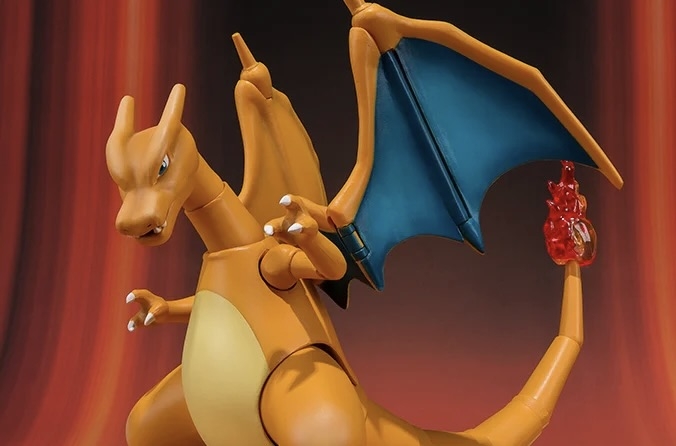
There are Charizard figures, and then there’s the S.H.Figuarts Charizard—the one that actually looks and moves like the fire-breathing menace you remember from late‑night anime marathons and rage‑quit Indigo League reruns. This premium, fully articulated Charizard action figure doesn’t just sit on a shelf; it spreads its wings, throws out flame effects, and dares every other Pokémon collectible you own to keep up.

At first glance, Bandai absolutely nails the iconic silhouette: long neck, horned head, thick torso, relatively short arms, stocky digitigrade legs, massive bat‑like wings, and the ever‑burning flame on the tail. The sculpt is clearly referencing the anime/XY & Z design language more than in‑game models, with softer transitions, rounded claws, and expressive eyes. The head shape is extremely close to the anime look, with a slightly rounded snout, recessed eyes, and pronounced horn sweep. The neck and tail segmentation follows natural curvature points, allowing S‑shapes that read as “organic” in motion even if the cuts are visible at rest. Charizard’s barrel chest and thick hips are well‑defined, and the arms are appropriately small. The wings are massive and dramatic, standing taller than the head when fully raised, which helps the figure dominate a shelf but can also make posing and balancing difficult at times.
Charizard is envisioned as a large, imposing creature, and this figure’s relatively modest size can diminish that sense of presence when displayed alongside other figures, particularly human characters from the same line. This discrepancy is not a result of poor design but rather a conscious decision to maintain consistency within the Pokémon sub-line, even if it comes at the expense of perceived scale accuracy.

From a sculptural standpoint, the figure is immediately impressive in how faithfully it captures the animated proportions of Charizard without drifting into the exaggerated musculature or hyper-textured realism that often affects Western interpretations of the character. The head sculpt in particular deserves extended attention, as it balances aggression and personality in a way that aligns closely with Charizard’s on-screen presence across the anime and films. The snout is neither too elongated nor too compressed, the brow ridge is subtly angled to convey intensity, and the mouth, while limited in articulation, is sculpted with enough depth and curvature to avoid the “static toy” look that plagues lesser figures. The eyes are sharply printed with a clean, high-contrast finish that gives the figure a sense of life even when posed neutrally.
Bandai’s Charizard sits in the S.H. Figuarts ecosystem but uses the original D-Arts Charizard body as its base, with only minor tweaks in color and joint tolerances on the later Figuarts release. Because it is essentially a reissue of the D-Arts sculpt, a lot of online chatter and older reviews refer to it interchangeably as “D-Arts Charizard” and “S.H. Figuarts Charizard,” which can be confusing when searching for it online.

The paint application is top-notch, with a rich orange hue on Charizard’s body, complemented by blue wing membranes and a cream-colored underside. The translucent flame effect on the tail adds a dynamic touch, simulating the flickering fire that is Charizard’s trademark. At its core, the figure’s primary orange coloration is deceptively complex. What initially reads as a single, uniform hue reveals itself, upon closer inspection, to be a carefully calibrated blend of tones that shift subtly depending on light exposure and angle. Unlike some collectible figures that rely on heavy texturing to convey realism, this Charizard leans into smooth, animation-consistent surfaces, which ultimately makes it more versatile in display. Under bright lighting, the figure can appear almost cel-shaded, especially when paired with its flame effects.
Where the paint work becomes more assertive is in the secondary color zones, particularly the wing membranes and the interior of the mouth. The wings, in particular, demonstrate a thoughtful approach to contrast. The greenish-blue membrane color is applied cleanly within the sculpted boundaries, with minimal overspray or bleed onto the surrounding orange frame. The absence of overt panel lining or dramatic gradients might initially seem like a limitation, especially for collectors accustomed to more stylized or weathered finishes, but in practice it serves a very specific purpose. By keeping the paint relatively clean, the figure maintains a high degree of visual coherence with its animated source material.

Articulation is, as expected from the S.H.Figuarts line, one of the defining features of the figure, and in many ways it delivers exactly what experienced collectors would anticipate. The neck is composed of multiple joint segments, allowing for a surprising degree of expressiveness in head positioning. Charizard can look upward in a convincing flight pose, downward in a predatory stance, or tilt its head slightly to create a more character-driven display. The shoulders are engineered with a combination of ball joints and hinge mechanisms, enabling the arms to move forward, outward, and slightly inward without excessive obstruction from the torso sculpt. The elbows and wrists provide additional flexibility, though they are somewhat secondary in importance given the character’s design. The tail is another articulated component that contributes significantly to the figure’s display potential. Composed of multiple segmented joints, it can be curved, coiled, or extended to complement a wide variety of poses.
The wings themselves are a marvel of engineering on paper, featuring multiple points of articulation that allow for a wide range of configurations, from fully extended flight poses to partially folded resting positions. Each wing includes several hinge joints that can be adjusted independently, giving collectors a high degree of control over the silhouette of the figure. However, this complexity introduces a degree of fragility that cannot be ignored. The joints, while functional, can feel delicate, and repeated adjustments may lead to loosening over time. This creates a subtle tension in the ownership experience: the figure invites dynamic posing, but it simultaneously encourages a certain level of caution to preserve long-term integrity.

The legs are where the figure begins to reveal both its strengths and limitations. On one hand, the hips allow for a respectable range of motion, and the knees bend enough to create grounded, crouching poses that feel natural. The ankles are particularly well-designed, incorporating rocker functionality that helps compensate for the figure’s top-heavy nature. On the other hand, the overall stability of the figure can become an issue when attempting more ambitious poses, especially those involving extended wings or elevated tail positioning.
The tail flame deserves special mention. It’s cast in layered translucent plastic (typically two tones: a deeper orange or red toward the “core” and a lighter, brighter outer layer), which catches light beautifully and sells the idea of a living fire. Despite being attached at the thinnest point of the tail, it is firmly secured and doesn’t feel wobbly or fragile during normal handling. The wing joints are engineered to allow both classic “T‑pose” spreads and more folded, bat‑like stances without swapping parts.

The S.H.Figuarts Charizard comes in a windowless, collector-style box that feels more like premium hobby gear than toy aisle fodder. Instead of a big plastic window, you get bold Charizard artwork and a layout that leans into that “import collectible” vibe from the moment you pick it up. Inside, the figure and flame effects are packed in a secure inner tray, so everything arrives intact and presentation‑ready.

Community reception over the years has been largely positive, with most critiques centering on scale and fragility rather than fundamental design flaws. Many collectors consider it to be the best articulated Charizard available, particularly for those who prioritize anime accuracy and dynamic posing over sheer size. Others view it as a complementary piece rather than a centerpiece, best displayed alongside other S.H.Figuarts Pokémon figures.

Because the Figuarts Charizard is essentially a straight re‑release of the D-Arts with some tweaks, the main differences are:
• Color tone: Slightly different orange and finishing, depending on lighting; some collectors prefer the original, others prefer the reissue.
• Joint quality: The reissue is often reported as having tighter joints and slightly improved wing articulation, reducing sag under effect weight.
• Accessories: The Figuarts release includes the full modern effect set; earlier releases could have leaner accessory packs depending on region and edition.
If you already own the D-Arts and it’s in good shape, there is little functional reason to upgrade purely to the Figuarts; the reissue mainly exists to give new buyers access without aftermarket prices.

From a fidelity perspective, this is arguably still the most “anime‑correct” fully articulated Charizard on the market, especially compared to more simplified Western toy‑aisle releases. The main aesthetic compromise is visible panel lines and segmented joints running through organic curves, particularly at the neck, tail, and base of the wings. When compared to other Charizard representations on the market, the figure holds its own in several key areas. Against lower-cost figures, it offers superior articulation, sculpt accuracy, and accessory integration. Against higher-end statues, it sacrifices some visual impact but gains significantly in versatility. Model kits, which occupy a different niche, may offer greater customization but lack the out-of-the-box polish and engineering refinement found here. If you just want a basic Charizard for a child or as a casual desk mascot, a cheaper mass‑market option is likely more appropriate. If you’re chasing “the best articulated Charizard figure,” Figuarts is still the benchmark. But if you’re curating a collection that reflects how much this franchise actually means to you—and you want a centerpiece that feels worthy of decades of Pokémon culture—this is the kind of Charizard that earns its spot.
Check Price And Availability
Amazon
This post includes affiliate links. If you make a purchase through these links, I may earn a commission.
