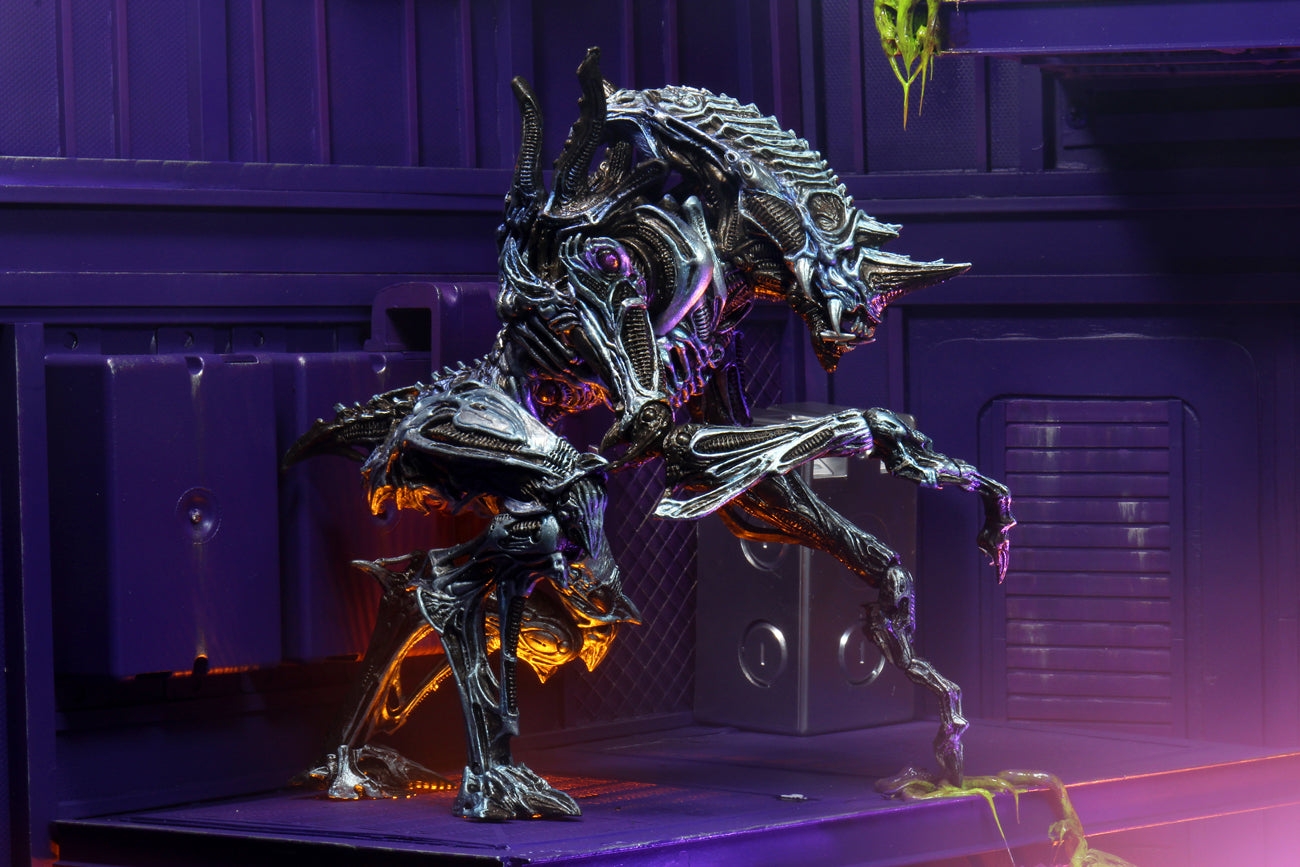
NECA launched their Kenner Tribute line in 2016 as part of Alien Day, initially reimagining the classic Kenner Ripley figure with appropriately garish retro colors and blister-card-inspired packaging. From there, the line grew into something genuinely special — homage to the toymakers of a less litigious, more creatively anarchic era. The first NECA Rhino Alien (let’s call it V1) arrived to enormous fanfare, leaning into that fiery orange-and-red translucent plastic that made the original Kenner figure so visually appealing. This figure is a repaint/re‑deco of NECA’s first Rhino Alien, but with colors and packaging that pay tribute to the later Kenner variant rather than the original orange version. If Version 1 was the gritty reboot, Version 2 is the technicolor dreamcoat of the Alien franchise. This variant utilizes a striking palette of deep blues, translucent plastics, and subtle purple highlights that pay direct homage to the vintage Kenner aesthetic.


To understand why this figure matters — and why collectors lost their collective minds when Version 2 was announced — you might need a quick history lesson. In 1992, with Alien 3 in theaters and the Aliens franchise riding high on post-sequel momentum, Kenner launched what is now one of the most beloved cult toy lines in action figure history. The concept: Xenomorphs inherit traits from their hosts. And Kenner decided that the terrifying, sleek Xenomorphs from Ridley Scott’s masterpiece needed to be mashed up with the animal kingdom’s most aggressive herbivores. The Ultimate Rhino Alien keeps the recognizable profile—elongated dome, massive horn, quadruped stance—but the body is now a dense mesh of tubes, ribs, vents and layered plating instead of smooth ’90s toy plastic.


Version 2 is all about the paint job; that’s the reason this figure exists as a separate release in the first place. Where the first NECA Rhino Alien went with blazing orange and metallic purple that echoed the original Kenner figure, this variant takes inspiration from Kenner’s later repaint, dialing the palette into a deeper, more ominous color scheme. The paint isn’t just slapped on; there’s a sophisticated finish that settles into the deep grooves of the sculpt, making the “ribs” and “wiring” of the Alien’s torso pop. The use of translucent material on the back of the head and the spinal spikes adds a layer of depth that catches the light beautifully—giving it a ghostly, deep-sea creature vibe. The effect is a figure that photographs beautifully in low light and looks genuinely threatening on a shelf, rather than the gloriously garish neon nightmare of its predecessor.


The paint work is clean where it needs to be clean, and deliberately rough and organic where the design calls for it. The teeth are given distinct light coloring that makes the jaw detail pop. The inner jaw receives its own paint treatment, separate from the head, which adds depth to what could have been an afterthought. The metallic paints pick out the layered armor and biomech elements, catching light on ridges, tubing, and horn ridges in a way that feels thoughtful. NECA leans into the translucent plastic on the skull dome, letting color gradients and internal texture shine through, something reviewers consistently call out as a visual highlight.


The chest plates are not flat segments; they’re stacked and slightly undercut, creating shadow pockets between layers that make the figure feel deeper and more complex in person. Around the abdomen, there are sculpted “pipes” and ribs that don’t just run straight—they curve, intersect and disappear under armor segments. Instead of a smooth toy back, you get something closer to a biomechanical engine bay: stacked vertebrae, panel seams, and pipe‑like trenches running along the spine. One of the more overlooked touches is how the back and spine are broken up into sculpt‑friendly segments that still read as a continuous exoskeleton. Instead of obvious discs or flat cuts, you get jagged plate edges that disguise how the figure actually moves.


The head is the centerpiece, featuring a massive, singular horn that looks capable of punching through a Colonial Marine’s APC. The skin texture oscillates between leathery hide and ribbed, mechanical plating, ensuring that every millimeter of the 7-inch scale frame feels intentional. Unlike the standard Xeno variants, this figure feels dense, providing a tactile satisfaction that justifies its “Ultimate” branding. Below the dome, the real treasure: a hinged jaw that opens and closes, revealing tusk-like teeth that lean more Alien 3bio-horror than playful toy-shelf creature. And for the pièce de résistance, NECA included an extendable inner jaw — that secondary mouth, the franchise’s most iconic body horror signature — that can be pulled forward for maximum cinematic menace.


Zooming in on the sculpts finer details, you’ll find:
• Tiny vents and grill‑like recesses on the torso and limbs that mimic industrial panels.
• Subtle divots and asymmetrical wrinkles around articulation points that suggest stretched synthetic “skin” over machinery.
• Raised ridges and micro‑lines along the horn and dome edges that make the transitions feel grown, not assembled.

These are the things you almost never see in promo images, because they only really come alive once lighting hits at a weird angle on your shelf at 11 p.m. while you’re wondering how you ended up with a ten‑inch rhino Xenomorph guarding your bookshelf.

Putting 30+ points of articulation on a figure this bulky is an ambitious feat of engineering. The Ultimate Rhino Alien handles it with surprising poise. The neck is on a massive ball joint, allowing the beast to look forward for a charge or tilt its head in that classic, curious Xenomorph fashion. The legs are sturdy—a necessity given the top-heavy nature of the sculpt—and the tail is bendable, which is essential for maintaining balance in more dynamic poses.

Even though this is a quadruped‑leaning design, the limbs are not just animal legs with Xeno skin; they’re built out of interlocking pistons, tendons, and armor ridges that visually justify the figure’s massive weight. Where the original Kenner Rhino was essentially locked on four stubby legs with only its head spring-loaded for action, the NECA version can shift dynamically from a low, charging quadruped stance to a rearing, front-claws-raised attack position.


The Ultimate Rhino Alien Version 2 comes in what NECA calls a deluxe window box — a collector-friendly, non-destructive package that you can actually open, display the figure, and then store your figure back in without weeping. The artwork on the front flap draws direct inspiration from the original Kenner blister card design of the early 1990s. Open the flap and you’re greeted with a clear plastic window revealing the figure itself, cradled in a shaped plastic tray. The sides carry additional artwork, and a promotional panel shows off other figures in the Kenner Tribute lineup.


There’s a tactile, almost nostalgic quality to the whole presentation that transcends mere packaging. They clearly understood that the packaging wasn’t just a box — it was part of the experience. It’s meant to hit your nostalgia receptors before you even cut the tape, and it succeeds without devolving into parody packaging.


The NECA Alien Ultimate Rhino Alien (Kenner Tribute) Version 2 is more than just a repaint; it’s a recognition of the meta-narrative that kept the franchise alive in the hearts of kids throughout the 90s. The packaging itself is a treat, featuring a gatefold window box that mimics the classic 90s art style, making it a “must-buy” for mint-in-box collectors who value the aesthetic of the era as much as the figure itself. You are getting a massive, 10-inch long, highly detailed creature that doubles the mass of a standard figure. Ultimately, the NECA Alien Ultimate Rhino Alien V2 is an excellent action figure — a precise, confident, well-executed tribute to one of the most delightfully strange corporate decisions in toy history, leveled up with modern craft and delivered with a genuine love for the source material that’s apparent in every detail from the removable dome to the folded mini-comic in the packaging tray. If you already own Version 1, the Version 2 re-paint is different enough to warrant a “double dip,” especially if you prefer the classic Kenner blue. It doesn’t chase movie accuracy; it chases the weird, hyper‑specific nostalgia of the Kenner era and actually delivers.

Leave a Reply